



Here’s an uncomfortable truth about New Year’s resolutions for bloggers: by the time you make them, it’s already too late for the first quarter.
A post you refresh on January 5 may not climb the rankings until spring. A pin you schedule in January peaks around April. And some travelers book their summer holidays in the very first days of the year while most bloggers are still writing their goals.
So we asked two successful travel bloggers and one of our partnerships managers a simple question: “What should travel bloggers do with their blogs right now so January pays off?”
Meet the experts


Millie (Stay Wild Travels). Travel blogger writing about [the UK, Peru and more]. She’s in the middle of her own pre-January overhaul right now.


Bri (Bucketlist Bri). Travel blogger and mentor to other creators. Digging into her data helped her double her affiliate revenue.

Alexandra (Partnerships Manager at Travelpayouts). She helps partners make sense of their data and find where their content can earn more.
Your 6-week plan at a glance
| When | What to do | Why now |
| This week | Pull this year’s data and find your top-earning posts | Everything else depends on knowing what already works |
| Late November | Fix posts losing clicks; cut or merge dead weight | Search engines need time to re-crawl and re-rank |
| December | Refresh winter, January, and early-spring posts; schedule pins | Updates need 6–8 weeks to settle, pins up to 3 months |
| Late December | Prepare your newsletter for the first booking days of January | Travelers start planning the year right after the holidays |
| January | Content sprint: publish and refresh daily for 30 days | Momentum compounds while competitors are still planning |
Now let’s go through each step.
1. Find the posts that already pay you
Most bloggers start the year by asking, “What should I write next?” All three experts start with a different question: “What already works?”
Take the time to do an honest assessment of your inputs and outputs. Are you publishing as much as you want to? Do you have a clear 3-month game plan? Questioning myself about this and digging deep into my Content Analytics led me to double my affiliate revenue.


Millie is doing exactly this right now. She’s finding her money-maker posts to double down on next year, and auditing her affiliate links, establishing which programs earn the most and where it’s worth switching.
Alexandra’s tip: let AI do the number crunching. Open Content Analytics (Content Analytics runs on Drive – if you’re wary of adding another script, Drive doesn’t replace or conflict with the ones you already use), select the whole of 2026, filter by the tools you use for manual placements (Links or Switch Links), and then export the report. After that, upload it to ChatGPT or Claude with prompts like these:
Which articles brought me the most revenue this year?
Calculate the median CR1, CR2, and RPM across my articles. Show me which articles performed above these benchmarks and which underperformed.
Group my articles by format (guides, itineraries, listicles, reviews), destination, and main keyword. Which groups bring me the most revenue?
The articles below your medians are your to-do list for December. Prefer spreadsheets? Export the report to Google Sheets and sort by hand – gaps jump out either way. For more ready-to-use prompts, see our guide to working with content data like a pro.
A rough benchmark from our product team: a CR1 of around 8% is a good result, and CR2 of 1% or higher.
2. Spot the posts that could earn more
Some posts get steady traffic and look fine at first glance, and yet they bring in less money than they could. Two checks help you find them.
Clicks down, impressions steady. Millie compares the last 28 days in Google Search Console with the period before. When a post’s impressions hold but clicks drop, Google still shows it, yet people choose another result. Often the fix is a sharper title or a fresher year in it, or a first-hand angle a competitor doesn’t have.
Posts that earn, but not from your links. Alexandra suggests one more check if you use Targeted Offers in Drive. Export the articles that brought the most sales through Drive and compare them with your manual-links report. If an article earns through Drive but your own links there earn nothing, that’s a signal: readers of this post are ready to book. That kind of article deserves your best manual placements too.
3. Refresh for next season before it starts
Timing is the whole trick here. Update a post when the season begins, and you’ve already missed most of it.
Look back at your own peak. Alexandra’s example: if you write about Japan and your sales jump during cherry blossom season, filter your report from January 1 through the end of April. The articles that performed best then are the ones to refresh now, because they’re the most likely to top the charts again.
Follow Millie’s calendar. She updates seasonal posts 6–8 weeks before their peak, so they have time to settle in the rankings. Her winter and January content is being refreshed now, and spring posts will be in January. On Pinterest, she plans even further ahead – about three months before the peak, which means she’s pinning winter content today.

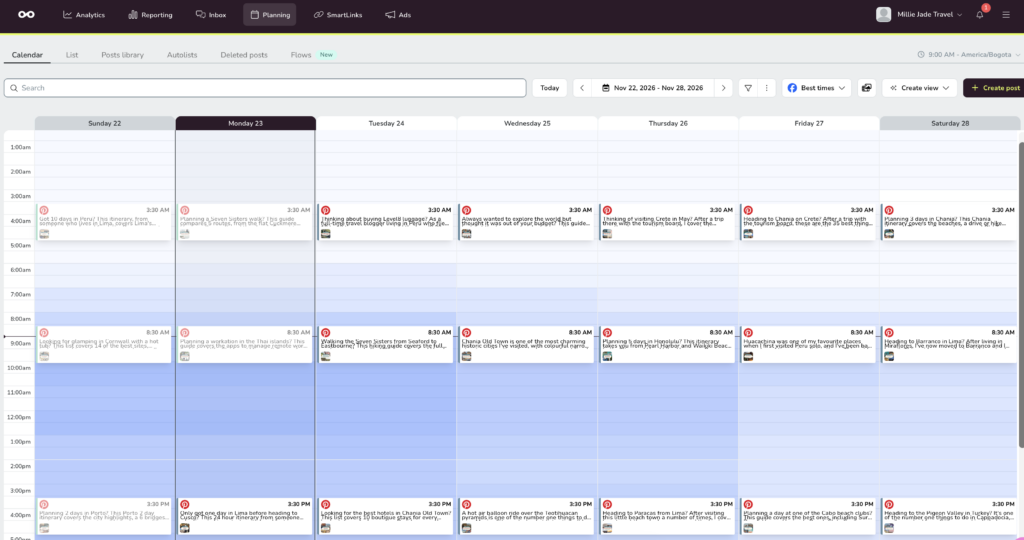
Make it first-hand and fact-check it. While she’s refreshing posts, Millie rewrites their texts and titles so they read like personal experience. She also makes sure that information is right for the coming year – whether the hotels, restaurants, and tours she recommends are still open.
4. Make room for your strongest content
Delete or merge underperforming posts. Millie removes or combines posts with no traffic and no income because they can drag the whole site down. Two thin posts about the same city often work better as one strong guide.
Build out your strongest clusters. Put your energy into topics where you have real expertise. For Millie, that’s the UK and Peru.
I think people often forget their home locations, and that’s where they can rank highest the most.

Update your hub pages while you’re there so every cluster has a strong entry point.
Check the boring tech stuff. Millie found an old font file that was slowing down her site. Ten minutes with a speed test can be worth more than a new post.
5. Bet on your best sellers
Measure earnings per reader. Bri’s advice is to find the type of post that converts best, even if it gets fewer readers. A niche itinerary read by 500 people can earn more than a viral listicle read by 20,000.
Once you can visually see what is converting the best, you can apply that to future clusters and single posts.
She also suggests a simple question that can help focus your time: “What’s your highest-earning revenue hour?” That is, which single action brings you the most income next?
Find the products your readers already love. Alexandra recommends opening the Bookings report, choosing Links or Switch Links and your best-performing brands, and checking which tours or hotels sold most often. If there are clear leaders, give them a dedicated post or feature them more prominently where they already appear. Your readers trust these recommendations, so they have the best chance to convert.
Rethink your brand mix. In the Performance report, compare brands by conversion rate, average revenue per booking and average revenue per click. Push the brands that win; scale back the ones that don’t. And don’t stick to one brand per vertical – A/B test alternatives and try platforms that are popular in your destinations.

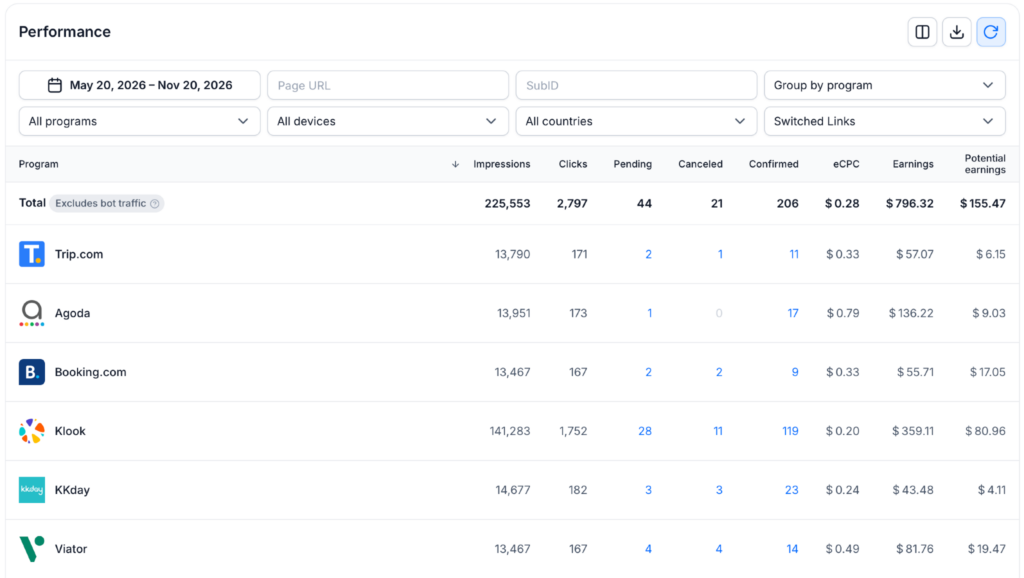
Make every post earn. Millie goes through her whole blog and makes sure every post is optimized for affiliate links.
6. Be ready for January’s first booking rush, then go deep
Prepare for the first booking days of the year. In the UK, the first Saturday of January is known as Sunshine Saturday – one of the most popular for booking holidays. In 2027, that’s January 2. Millie is already preparing a newsletter for it. Whatever market your readers are in, find out when they start booking and have your best posts and offers ready before that.
Run a content sprint. Millie’s plan for the next 30 days: publish one new article and refresh one or two old ones every day. Ambitious, but even half of that adds up to dozens of improved posts by February.
Protect your focus. Bri’s final piece of advice is the least glamorous but perhaps the most important:
Take 2–3 weeks, or 2–3 months if it’s a larger project, and do the unsexy, daily work required to get it done. Everyone asks me how I grew my blogs or my passive income, and really it’s no different for an expert than it is for a beginner: you write and publish, and keep going.
Your pre-January checklist
Save this list and tick off tasks over the next six weeks.
- Export your 2026 report from Content Analytics and find your top-earning posts
- Ask AI to find posts above and below your median CR1, CR2, and RPM
- Audit affiliate programs – see what earns and what to switch
- Compare clicks and impressions in Search Console and fix posts losing clicks
- Check which posts earn through Drive but not through your own links
- Filter last year’s peak season and refresh the posts that won it
- Refresh winter and January posts now and spring posts in January
- Schedule seasonal pins about 3 months ahead
- Delete or merge posts that bring nothing
- Grow your strongest clusters and update hub pages
- Run a site speed check
- Prepare a newsletter for the first booking days of January
- Block time for a 30-day content sprint
A lot of this comes down to one question: which posts have booking intent you’re not earning from yet? Finding them by hand across hundreds of articles takes days.
Drive does it automatically. It finds links you’re not earning from, adds relevant offers for your readers, and shows what really works. It also runs alongside the scripts you already use, so you don’t need to remove anything to try it.
You don’t have to tick off every item before January. Pick the two or three steps that fit your blog best and start this week – your January self will thank you. Happy holidays from all of us at Travelpayouts, and here’s to your best blogging year yet!