
If you’re a blogger, you’ve probably noticed one thing about Google over the years: it never sits still. And now, with the rise of AI, we’re stepping into a whole new search era, one that feels very different from the traditional SEO playbook we’ve all relied on.
Enter Google’s Search Generative Experience (SGE). If you haven’t heard much about it yet, you should, because it’s slowly reshaping the way people search, discover, and engage with content online.
Instead of the familiar list of blue links on SERP, you may have noticed Google already serving up AI-powered summaries and direct answers right at the top of search results. Sounds convenient for users, right?
For us bloggers though, it raises a big question: how will our blogs be clicked on now?
When I first noticed about SGE, I was both impressed and slightly worried.
Impressed, because the summaries felt conversational and quick to digest. Worried, because the spotlight on our blogs could get smaller if Google is already serving answers upfront. But here’s the thing – with every change, there’s also an opportunity. And understanding how SGE works is the first step in making sure our content stays visible and relevant.
What exactly is Google’s SGE?
Let’s break it down simply. Google’s Search Generative Experience is an experiment (currently rolling out in stages) where Google shows AI-generated summaries at the very top of search results.
Picture this: someone types “best places to visit in Italy in October.” Instead of the classic page full of blue links, the first thing they see is a colourful box with a short, conversational summary.

That entire summary is generated by Google, but here’s the kicker: it’s pulled from real websites like yours and mine.
When I tested it for a few of my travel posts, I noticed snippets from well-structured blogs appearing directly in those summaries. That was my “aha” moment: SGE isn’t about eliminating blogs, it’s about selecting the clearest, most relevant sources to power Google’s summaries.
How SGE changes the traditional SEO lens
For years, we’ve been trained to chase rankings, fighting tooth and nail to land in that coveted top spot in SERPs. But with SGE, the game looks a little different. Here’s how.
Ranking isn’t everything anymore
For years, being on the first page of Google – ideally in the #1 spot – was the golden ticket for traffic. If your blog ranked high, you could almost guarantee clicks. But with SGE, that formula doesn’t hold true anymore.
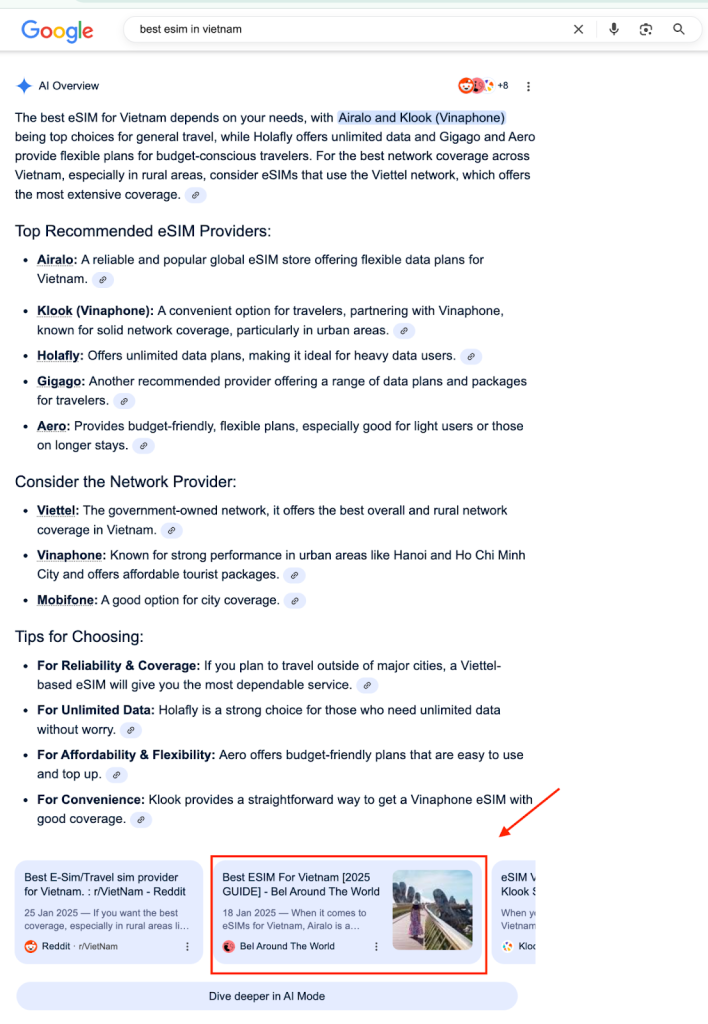
Here’s why: SGE puts an AI-generated summary box above the search results. This means that even if your blog is ranked #1, users might never reach it because their question has already been answered in the AI summary.
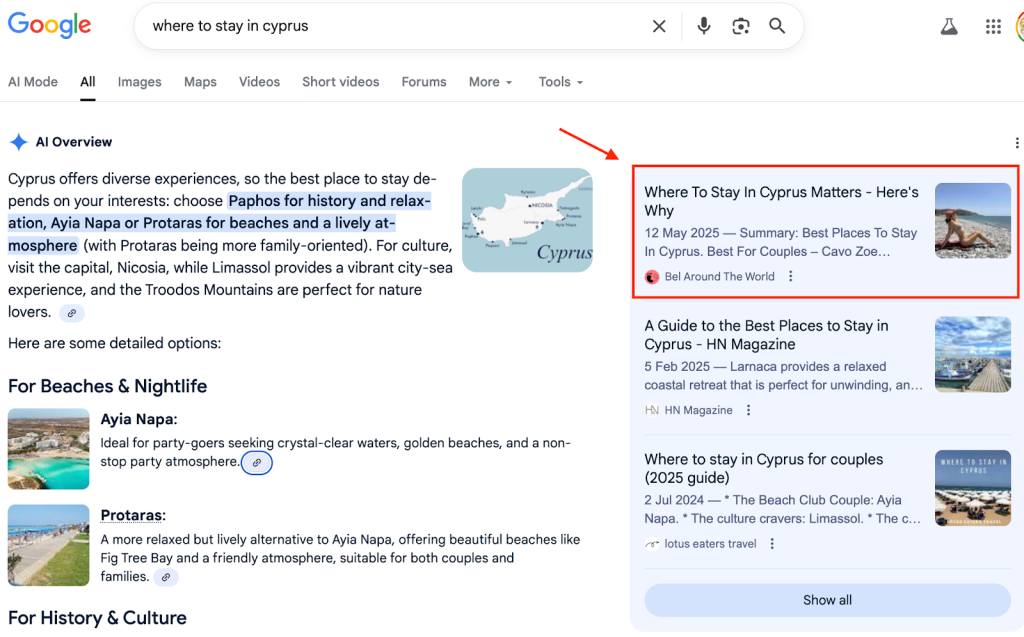
That can feel discouraging, but here’s the flip side: visibility is no longer tied only to rankings. Your content can appear directly inside Google’s SGE summary, which is arguably more powerful than a traditional top ranking.
What you can do
- Optimise for inclusion, not just position. Write content that answers the user’s question in a direct, clear, and complete way. Google is looking for “quotable” snippets to pull into SGE, so your content should provide clean, standalone answers.
- Use conversational subheadings. Instead of “Weather in Rome,” try “What’s the weather like in Rome in October?” This mirrors the way people search.
- Add short summaries after sections. End a section with a one-sentence wrap-up — these concise answers are exactly what SGE looks for.
Content needs to be crystal clear
Think of SGE as a high-speed skimmer. It doesn’t read like a human, absorbing your storytelling arc or witty jokes. Instead, it scans for structure, clarity, and key takeaways.
When I compared blog posts that SGE pulled from versus those it ignored, one thing stood out: the chosen posts were neatly organised. They used clear headers, short paragraphs, bullet points, and direct answers. Posts that were cluttered with walls of text, long introductions, or vague descriptions didn’t stand a chance.
What you can do
- Break up text. Keep paragraphs short (2–4 sentences max). Long blocks make your content harder to scan.
- Use headings strategically. Each H2 or H3 should answer a specific question.
- Add bullet points for lists. Whether it’s packing essentials, steps in a process, or quick facts – bullet points make it easy for Google (and readers) to extract information.
- Front-load important info. Don’t bury the answer halfway down the page. State it clearly, then elaborate with examples and stories.
| Instead of writing | Try |
| “Rome in October can be lovely, as the weather is milder than in summer, though you might still get the occasional shower.” | “Rome in October has mild weather, averaging 18°C (64°F), with occasional rain. Expect fewer crowds compared to summer.” |
The second example is structured in a way that SGE can easily lift into a summary.
E-E-A-T takes center stage
Google has been pushing E-E-A-T for years, but with SGE, it’s more important than ever. Why?
Because when AI is deciding which sources to trust enough to display inside its summaries, it prioritises content that demonstrates real-world credibility.
For us travel bloggers, this is actually an advantage. Unlike large corporate sites, we have first-hand experiences. Google wants that.
A generic article about “Top 10 Things to Do in Bali” might list the usual suspects (Ubud Monkey Forest, Tanah Lot, etc.), but what makes your post valuable is that you can say:
- How much it costs you to enter
- What time of day is less crowded
- What went wrong (like arriving at a temple only to find it closed early for a ceremony)
Those are signals of real experience that generic posts can’t replicate.
What you can do
- Be specific. Include costs, timings, transportation details, and lessons learned.
- Add your perspective. Instead of “X is beautiful,” explain why it mattered to you. Did it feel less touristy? Did it surprise you? Was it overrated?
- Show authorship. Use an author bio with your credentials (even if it’s simply: “I’ve travelled to Bali three times and stayed in both budget hostels and luxury villas”). It signals authority.
- Use photos. Original images are powerful credibility markers. Even if Google doesn’t directly use them in SGE, readers notice.
Opportunities for bloggers in the age of SGE
While SGE feels intimidating, it’s not all bad news. In fact, it creates opportunities for bloggers who can adapt.
- Authority building. If Google cites your blog in the SGE box, it positions you as an authority. Readers may not click immediately, but being seen alongside bigger sites builds credibility.
- Answer-driven content performs better. By writing in a way that directly answers questions, your posts are more likely to be picked up by SGE. Think FAQs, how-to guides, and step-by-step breakdowns.
- Niche voices can shine. Big travel sites often lack the personal touch. A blogger who writes from real experience – like how it actually feels to travel with kids in Peru or manage on a $30 per day budget in Bali – has a unique advantage.
- Long-tail search is expanding. Conversational queries mean more opportunities to rank for detailed questions. This levels the playing field for smaller blogs.
If you’d like to learn more about how you as a blogger can use SGE to your advantage, as well as challenges to take note of, you can subscribe to my weekly newsletter where I spill all things SEO-related.
Google’s Search Generative Experience is a big shift, no doubt. It changes how people interact with search results and forces us to rethink traditional SEO. But it’s not the end of blogging – far from it.
If anything, it’s pushing us back to what blogging was meant to be: real people sharing real experiences in a way that helps others. By focusing on quality, clarity, and authenticity, we can position our blogs not just to survive, but to thrive in the SGE era.
So yes, the landscape is changing. But as bloggers, we’ve always been adaptable. And in this new chapter of search, the bloggers who stay human, personal, and useful will be the ones who stand out.