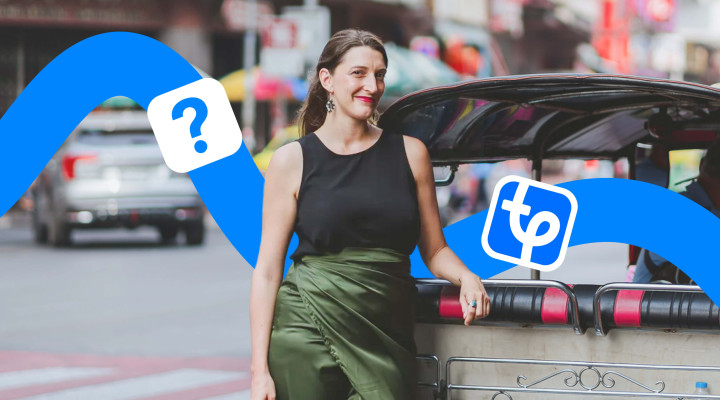
Alex Wieteska-Gasior has spent more than 12 years traveling across 50+ countries, calling places like the US, the UK, China, Mexico, and Italy home at some point.
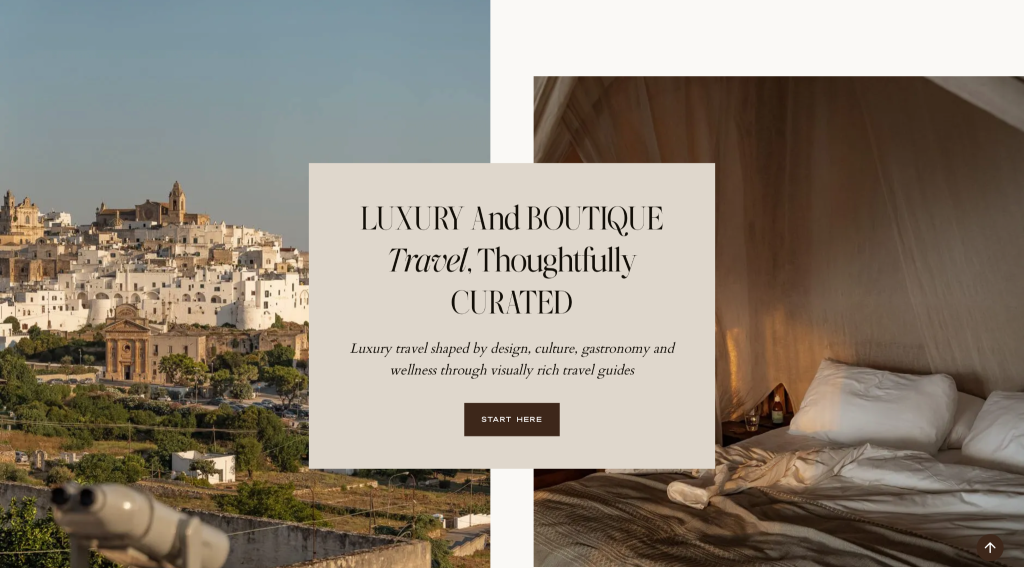
These days, she splits her time between Puglia and Mexico while running Roam & Thrive, her luxury, design, and wellness travel blog. Well over a million (yes, million!) readers enjoy the blog every year.
What makes Roam & Thrive interesting is that it stays strictly within its niche. In eight years, Alex has never recommended a hostel, a budget option for the sake of broader appeal, or anything she wouldn’t genuinely choose herself. So, she’s claimed the luxury niche.
This selectiveness is a big part of why she has earned $9,500 in six months on Travelpayouts. Let’s look at how she does it, and there may be something worth borrowing for your own content.
Not for everyone, and that’s the point
If you ask Alex why there isn’t a single hostel on Roam & Thrive, she’s not afraid to be honest.
I couldn’t convincingly recommend hostels because I don’t stay in them. I personally have very little interest in hostels and doing things on a budget.
The beauty about travel blogging is that creators can build successful content around so many styles of travel. Alex’s style is simply more personal: she only publishes what she’d genuinely recommend to a close friend, even if that means covering fewer options.
Her background in art history adds another layer of authenticity. She pays close attention to architecture, interiors, and craftsmanship, and those details often shape what she chooses to feature on Roam & Thrive.
Luxury means something quite different to me than it did ten years ago. It’s less about marble bathrooms or thread counts and more about thoughtful design, exceptional hospitality, beautiful locations and experiences that genuinely improve a trip.
Swapping traffic volume for high-intent readers
Not writing about anything she wouldn’t personally stand behind shrinks her potential audience, but to Alex it’s a worthy trade-off.
The audience is highly targeted… but it’s a smaller audience than mainstream budget travel. You can’t rely on sheer traffic volume in the same way, so quality, trust, and authority become much more important.
What the blog loses in volume, it gains in intent. Readers arrive already planning to spend, and that higher intent can make a smaller, more focused audience especially valuable. When readers trust the recommendations, that’s worth more than reach.
Every platform has its purpose
Roam & Thrive is a highly visual blog, which made Instagram a natural fit. Alex has built an audience of nearly 14,000 followers on the platform, where she focuses on photography and useful travel content.
Instagram plays a different role in her business than the website – while her website drives traffic, her Instagram page builds her brand.
Alex sees very few bookings or website visits coming directly from Instagram. Instead, it serves as the face behind Roam & Thrive, helps Alex stay connected with her audience, and lets her share places more immediately than a long-form guide can. For hotels and tourism brands, the Instagram page doubles as a portfolio of her work.
I do think it strengthens the overall business in ways that are hard to measure.
Still, maintaining Instagram comes with a real trade-off. Producing photography, video, social content, and long-form articles takes up a lot of time, and Alex doesn’t see Instagram as essential to the website itself.
I’ve consciously chosen to put most of my energy into building something I actually own, which is the website.
Pinterest has a more direct role in driving traffic, since people use it while searching and planning future trips.
Pinterest has also been an important part of the business over the years, particularly because people use it as a search engine when planning future travel, and my photography has always done well on Pinterest given how visual the platform is.
So for Alex, each platform serves a specific purpose: The website is the core business, Pinterest helps people discover the content, and Instagram helps build the brand.
Even the commission has to earn its place
When Alex recommends a tour, it has to survive the same “would I tell a friend” test as every hotel on the site.
Even within her luxury blog, Alex tends to recommend private or small-group experiences such as boat charters and food tours.
My readers trust that every recommendation has been carefully chosen, and protecting that trust is always more important than earning a commission.
Her focused approach is helping those recommendations convert. For example, Viator has brought in $3,870 over the past six months alone.
But doing everything herself has a limit; even the most hands-on solo operator needs a second pair of hands. Alex’s choice was Drive.
Finding the right kind of help
Alex manages Roam & Thrive by herself while also running a photography studio on the side. Between the two, keeping track of every affiliate opportunity across hundreds of destination guides and hotel articles didn’t seem possible.
The biggest challenge was making sure I wasn’t leaving revenue on the table. I have hundreds of destination guides and hotel articles, and manually keeping track of every possible affiliate opportunity just isn’t realistic. I wanted a solution that could work in the background without taking time away from writing and updating content.
She chose Drive from Travelpayouts because it promised to bring in additional revenue without the need to work additional hours.
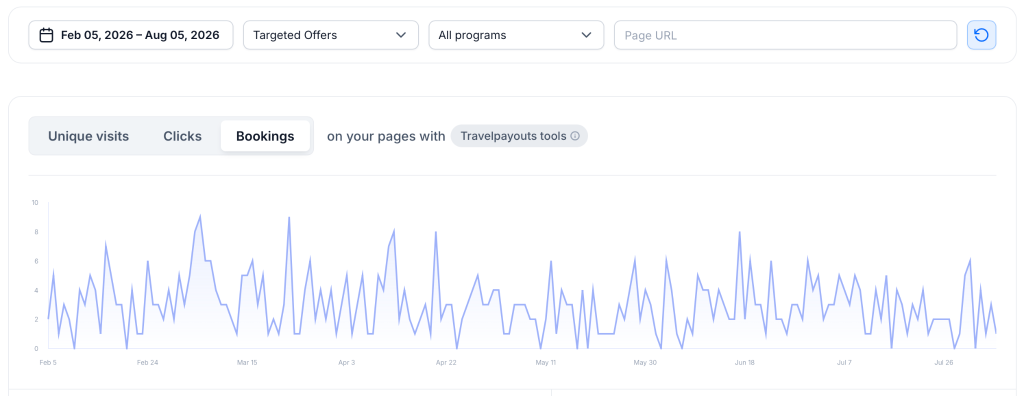
The setup was fast and easy, and the payoff has become a reliable part of the business. Travelpayouts has brought in $9,500 for Roam & Thrive over the past six months – $4,500 of it from Targeted Offers alone.
Knowing that relevant affiliate opportunities are being captured across the site without manually updating every article is a huge time saver.
That’s the beauty of Targeted Offers. It reads each page the way a person would and works out what a reader is actually planning based on the content itself. Then it surfaces the specific offer most likely to match that intent in a separate window.
It runs continuously in the background, across the entire site at once. That means opportunities that might otherwise sit unnoticed in a three-year-old post can start earning without anyone having to go back and find them.
The impact wasn’t an overnight spike, but over the following months I noticed more bookings being attributed and a steady increase in affiliate revenue from existing content. That’s probably the biggest advantage.
If there’s one takeaway
Of course, no single approach fits every blog – everyone builds theirs differently. But Alex’s key piece of advice for anyone starting a blog is simple: Treat it like a business from day one.
For Alex, that means running Roam & Thrive with the structure of a 9-to-5, even when she’s on the road. It also means treating travel as something worth being selective about.
No hostels, no budget group tours and no letting a platform’s size decide what she recommends. For Alex, quality content comes down to one thing: would she genuinely recommend this place or experience to someone she knows? That question has shaped Roam & Thrive from the start.
Join the Travelpayouts partnership platform
Join todaybrands