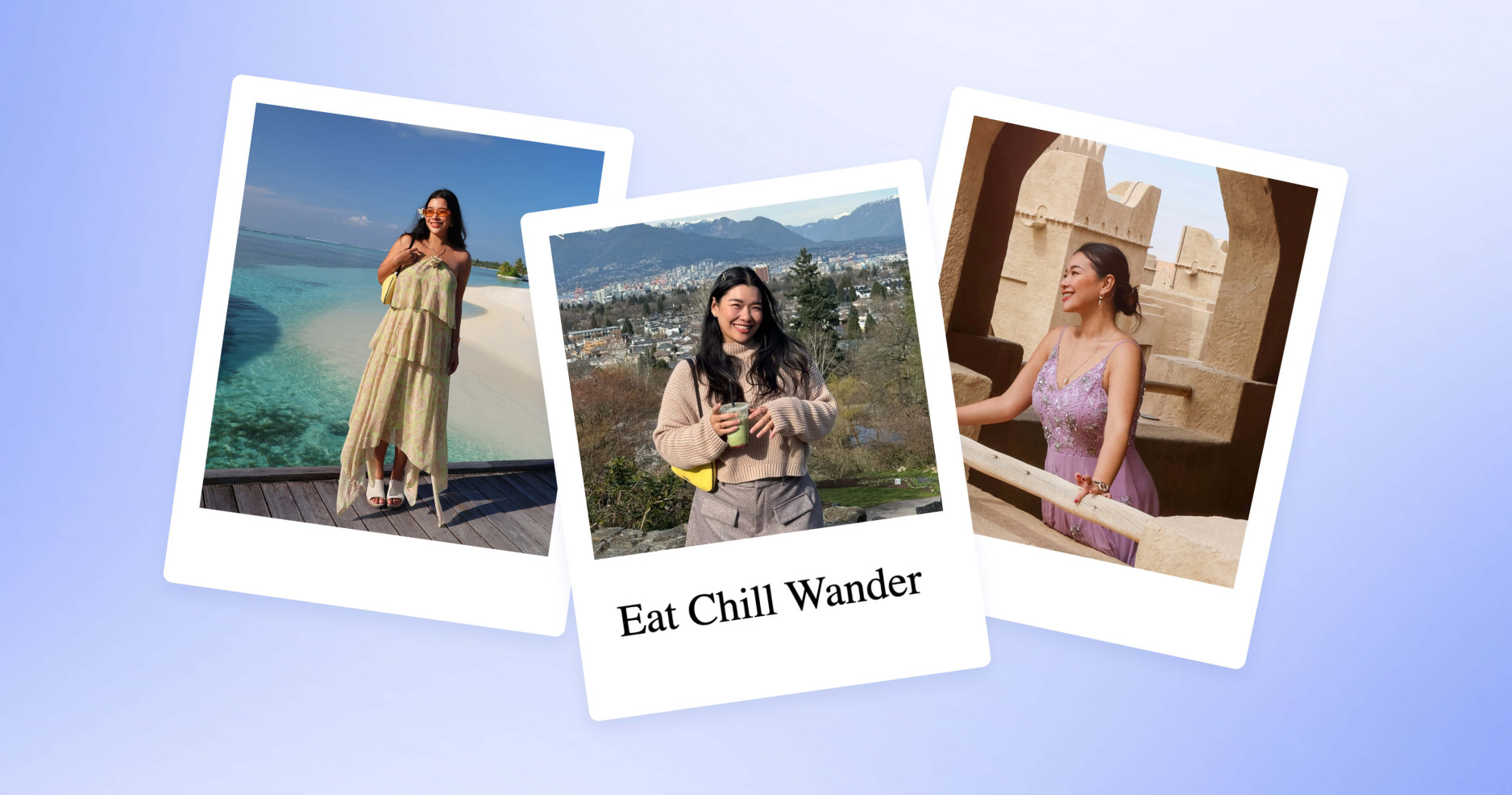
Ask most creators why they do what they do, and you’ll hear something about freedom or full-time travel. But not Natthawan Santiphap. It’s stereotypes that keep her going.
Wait, what?
Let Natthawan explain:
I dislike seeing people stereotype countries they’ve never visited. Part of me wants to promote a better understanding between people across the world. Something that’s normal here can be different there. Not everywhere has to be the same, and that’s beautiful.
Of course, her website, Eat Chill Wander, is also a business, and her main source of income. Still, Natthawan has found a way to stay true to herself while building her blog. Read on to learn how.
From friends to followers
Natthawan, who’s from Thailand, has traveled to 104 countries across six continents. More than 40 of them she visited before she started her blog in 2017.
That order matters. Eat Chill Wander didn’t begin as a business plan. It began because she was traveling a ton and her friends kept asking the same questions.
Like how to get there, where to go, and other details. I used to write notes and send them to my friends. Then I started just posting those notes on social media and my website.
Nine years later, Natthawan’s basic approach hasn’t changed: she travels out of passion, and she writes like a helpful friend. For her, anything else would be selling out – and she’s consistently avoided the temptation to do so.
Three things Natthawan says no to
Most creators’ stories are about what they’ve added: more platforms, more posts, more collaborations. Natthawan’s story is easier to understand through what she turns down.
- Press trips that don’t show her the destination. She’s selective, and she only says yes when the trip shares her purpose: actually getting to know a place.
- Trips planned around content. The trip comes first, the guide comes after.
- Chasing followers. She posts on Facebook, Instagram, and TikTok, but she doesn’t optimize for growth there.
I honestly don’t focus on it as much as making sure my website works well. So I’d say I let it grow organically.
None of that looks like a growth strategy. Yet it’s exactly why her blog has found success.
She gets to know a place before she writes about it
Instead of just maximizing clicks, Natthawan uses her blog to share thoroughly researched guides inspired by a genuine love for exploration.
Before publishing the travel guide on each place, I try to make sure I’ve talked to as many people from that country as possible. I also love to read at least one book or see a movie from that country to try to understand as much as I can.
This is the reason her guides keep earning organic search traffic long after they’re published – they radiate expertise.
The challenge: there aren’t enough hours in the day
Of course, all this research takes a lot of time. And the work doesn’t end when she finishes writing – she still has to monetize her content.
(For context, Natthawan does everything herself, without a team, editor, or assistant. She’s even had to pull back on long-form video content because it takes so much effort.)
So Natthawan had a dilemma: every hour spent monetizing manually was an hour not spent on the research that made her guides worth reading. And monetization done wrong could change how her content felt, which might ruin her blog.
She needed a monetization method that was easy, efficient, and smoothly integrated into her writing.
She found a solution… in someone else’s blog
Most partners hear about Drive from us. Natthawan found it on her own.
Earlier this year, she noticed that travel sites were generating automated offers for deals related to what she was reading.
I was wondering where those targeted offers were coming from, and I found out it was from Drive.
What she had spotted was Targeted Offers. It’s one of the functions inside Drive, Travelpayouts’ monetization system for travel websites. Drive analyzes content and site visitors, then adds relevant travel offers where readers are most likely to book.
After experiencing the convenience of such offers herself, Natthawan decided to give Drive a go.
After a quick and easy setup, Drive started monetizing automatically. She noticed an immediate increase in her bookings – and she didn’t have to lift a finger.
Everything was automatic. It’s just one click.
The result: an extra four figures in three months
Natthawan joined Travelpayouts in May 2026 and got her first earnings in June. Between June and August, Drive added a four-figure sum on top of what her blog already earned. Three quarters of it came from Targeted Offers alone.
Two details make that number more remarkable. First, it’s extra income, not a redistribution of what she was already making. Second, it came from a site written entirely in Thai, for a Thai-speaking audience, which is a far smaller market than English-language travel content.
One click, one function, one new revenue stream. And Natthawan is free to immerse herself in the part of her work she cares about most: the research.
Natthawan didn’t set out to build a monetization funnel. She set out to change how people see the world, one destination guide at a time. But the funnel found her anyway, and now it quietly pays for the books, the conversations, and the slow research that make her guides worth reading in the first place.
Her only regret has nothing to do with monetization.
Before, I thought I didn’t know how to make content or what I had wasn’t enough. But actually if you’re really passionate about something, and you deeply care about it, that’s enough to start. I would tell myself to start way earlier.
It’s a sentiment we hear a lot from Travelpayouts partners – “I wish I had started sooner.” But if you can’t go back in time, at least you can start today.