How to promote affiliate links in 2026: TL;DR
Free promotion methods take time and require you to put effort into content creation and building your audience. Paid methods, on the other hand, present results more quickly but require a budget and a good understanding of your target audience. Plus, not every program accepts paid traffic, so it’s not a universal strategy.
- Fastest methods: Google Ads, Facebook and Instagram ads, YouTube Ads.
- Safest long-term methods: blog content, Reddit and forums, and email marketing.
| Method | Free or paid | Difficulty | Long-term potential |
| Blog content and SEO | Free | Medium | Yes |
| YouTube videos | Free | High | Yes |
| Free | Medium | Yes | |
| TikTok and short-form content | Free | High | Yes |
| Reddit and online forums | Free | Low | Yes |
| Facebook groups and communities | Free | Low | No |
| Email marketing | Free | High | Yes |
| Quora and Q&A platforms | Free | Low | Yes |
| Google Ads | Paid | Low | No |
| Facebook and Instagram ads | Paid | Medium | No |
| Native advertising | Paid | Low | No |
| YouTube ads | Paid | High | No |
What is the best way to promote affiliate links?
There is no single best way to promote affiliate links. It all depends on your niche, the product or service you offer, your available time, and your budget for promotion. For example, SEO and videos work well for travel, while Facebook groups might be more effective for promoting products for parents.
As for the budget, paid ads can be expensive but bring results quickly. On the other hand, SEO and social media are free yet require a long-term commitment and personal branding strategies. These promotion methods also have different levels of difficulty. To successfully promote your links with ads, you need to know what performs well, how to analyze the results, and how to compare your expenses to earnings.
You can’t just include your affiliate link in an unrelated or general piece of content or spam links everywhere. The internet is overflowing with content, and many niches are oversaturated, especially those offering high-ticket affiliate programs. Coupled with search and social media algorithm changes, a successful link promotion strategy should be sophisticated. No matter the channel, you need to build trust with your audience. Consistent, helpful, and relevant content is the best way to promote affiliate links in 2026.
Where to promote affiliate links for free
If you’re a beginner in affiliate marketing, free channels are a great way to get your first conversions. They are also essential for a long-term affiliate marketing strategy.
Blog content and SEO
You can naturally promote affiliate links and products on your blog or website. When people click on a comparison or a review post, they expect to see links and are ready to make a purchase based on your recommendation. That’s why this is one of the most popular promotion tactics, instrumental to many affiliate marketing success stories.
Blogs and websites get organic traffic thanks to SEO – a free method of content optimization that makes it easier to discover. Once written, an article can attract traffic for years, helping you receive passive income while traveling.
If you create your own website, you can place links inside articles as well as in your site’s interface, like menu buttons. Here is an example of an affiliate link placement:
Example of affiliate deep link placement
Features:
- You can create a website for free on your own or with minimal expenses (~$200).
- The main difficulty is making content that ranks in search results, which requires an understanding of SEO.
- This method is not the fastest way to promote affiliate links. You may not get traffic to your blog until several months after your content was created.
- The total revenue depends on the quality of your traffic and the products you offer.
| Join Travelpayouts and get access to our smart monetization for travel bloggers. With our AI tool, you can automatically convert regular links on your blog to affiliate ones, add widgets, and link previews. |
YouTube videos
YouTube is another great way to promote your affiliate links. Videos are a high-conversion content format. Per Wyzowl’s 2026 statistics, 85% of people made a purchase after watching one.
For example, you can record product reviews or any kind of video in which you promote goods or services. You can’t always place a link directly to the video (for example, as a tooltip), but you can add affiliate links to the video and channel descriptions. Here is an example of affiliate links used on YouTube:
Example of affiliate links on a YouTube channel
Features
- An affiliate link in a YouTube video can bring conversions long after it was published if the content stays interesting and relevant to your target audience.
- Not all brands accept traffic from YouTube and other video-hosting platforms. If that is the case, you can drive traffic to your website content that includes affiliate links.
- In addition to your own videos, you can promote links in other people’s videos. For example, in the comments. However, as with any other platform, spam of any kind is prohibited.
- An alternative method of promoting your link on video platforms can be a promo code. Some brands provide promo codes to popular bloggers, which your audience can use to get a discount. A personal promo code allows brands to understand which affiliate marketing partners facilitated the sale and pay commissions accordingly.
Pinterest affiliate marketing is another great strategy to promote products or services. Visual content on Pinterest is a great source of traffic that you can send either directly to the advertiser’s website or to your own site and, from there, to the advertiser’s site. Both options can work, so experiment to find the most effective approach for you.
Pinterest is a great channel to make traveling a profitable hobby. Read the story of Oke, the creator behind Okeventures.com, to learn the best approaches for using this traffic source.
Here is an example of how you can drive traffic to a third-party website from Pinterest:
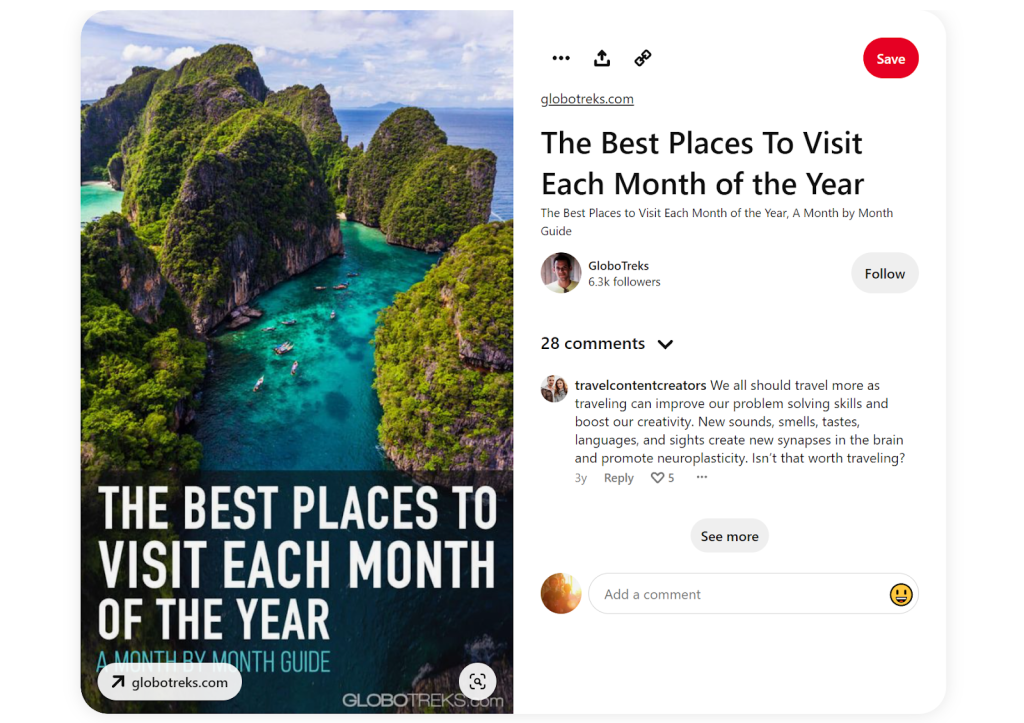
In this example, the author sends visitors first to his site and, from there, to advertisers’ sites:
You can do the same, or send traffic directly to brands that allow it. Join Travelpayouts to earn money from Pinterest posts, working with over 100 travel brands that pay up to 40% commission.
Features
- Pinterest works well for several affiliate marketing niches, like travel, parenting, beauty, fashion, or DIY.
- Pinterest has a predominantly US audience, so it’s perfect for an affiliate program targeting the country.
- Any photo or other form of graphic content can be a subject of copyright. So, while choosing pictures, remember to credit the author or use pictures that you’ve taken or made yourself.
TikTok and short-form content
TikToks, Instagram Reels, and other short-form videos are some of the best ways to promote affiliate links as they are popular across demographics. On TikTok, you can add clickable links to your videos for a seamless in-platform shopping experience. Other options to promote an affiliate link include links in bio and stories.
This method works especially well for physical products and visual-first content. Apart from just videos, you can also live-stream to showcase what you’re promoting and interact with your audience, answering questions or sharing tips.
Features
- Social commerce is one of the biggest recent affiliate marketing trends. More and more social media platforms now offer direct shopping features.
- Based on Statista’s data, countries with the largest TikTok user base include Indonesia, the US, and Brazil.
- Just as with YouTube, you can use personal promo codes for easier traffic attribution.
Reddit and online forums
Every day, 126.8 million people visit Reddit, so if you advertise your link there, you’ll reach a massive audience. There’s another benefit to this strategy: the platform has consistently gotten top Google search rankings across different industries. According to SE Ranking, Reddit achieves top 3 placements for over 10% of keywords from 20 different niches.
Besides Reddit, there are plenty of active forums in almost every niche. For example:
Posting or replying to other members with helpful advice, you can naturally advertise your affiliate links. For example, recommend the best Thanksgiving flight ticket or other products to earn with an affiliate program.
Features
- Forum and community owners can set their own rules for using affiliate links. Be sure to read the rules in advance.
- Your recommendations, including affiliate links, should be relevant and useful. Don’t spam in pursuit of a larger reach.
- Being an active member of the forum and community takes a lot of time. It is unlikely that every message will bring you a commission. Plus, some of your messages may not even have affiliate links.
- Since you publish affiliate links on other sites, you will not be able to control or influence them. For example, the platform owner may remove the link after a few months.
- If the topic is popular, your old forum and community replies can be profitable for a long time.
Facebook groups and communities
Communities are another popular online communication channel in addition to forums and exist across many niches, like the Solo Travel Society for travelers. You can usually freely promote your affiliate links in social media groups, as long as you don’t spam.
Depending on the platform, the content, and how exactly you integrate them, affiliate links will appear differently. Here’s what it can look like on Facebook:
Example of links to travel services
To reach your audience, you can create your own group or page, or become an active member of other people’s communities that do not prohibit the use of links.
Features
- Facebook can become both a direct source of traffic for your affiliate links and an additional source of income for your site. For example, you can drive traffic first to a page on your website that includes an affiliate link.
- If you post affiliate links in other communities, make sure you don’t break the rules. Page owners often restrict promotion.
Email marketing
If you’re wondering how to promote affiliate links without external platforms, email marketing is your answer. You can build your email list through your website or social media following, then recommend services or products to your email subscribers.
You can use many email marketing platforms, like Mailchimp or Kit, to send messages. Most offer drag-and-drop email editors, so you don’t have to know HTML to create newsletters. If you want to go a step further, email marketing allows you to segment your audience, personalize messages, and use automation to advertise your links more effectively.
Features
- Email marketing is a channel of direct communication, meaning there’s no social media or search algorithm to limit your reach.
- Using email software, you get access to analytics and can track open rate, click rate, and other metrics. Some tools also allow you to run A/B tests to experiment with subject lines, design, CTAs, and other content elements.
- The most difficult part of this approach to affiliate link promotion is building a subscriber base. This can take a long time, especially if you don’t already have a loyal audience. That’s why email marketing often works better as an additional strategy, not the primary one.
Quora and Q&A platforms
Q&A platforms like Quora help users exchange advice and recommendations on various topics, so they are a great fit for affiliate marketing promotion.
Just like with forums, you can promote an affiliate link inside your answer to a person’s question, for example:
Example of links in a Quora answer
Features
- This is one of the best ways to promote affiliate links, as you can earn fast. The traffic is already there; you just need to find an appropriate page and organically (without spamming) help people by answering their queries.
- Read the rules before you start posting links on Quora and other Q&A platforms. Affiliate links may be more regulated than general recommendations or completely prohibited.
- Spam is banned and constantly monitored on Quora and most other major Q&A platforms. You can successfully post links for several months and then get banned for making a single bad post. This risk is important to consider in your strategy.
- Quora pages are well-indexed and can bring you traffic not only from the platform itself, but also from Google.
Paid ways to advertise affiliate links
If you have the budget and knowledge for it, you can add paid promotion to your affiliate marketing strategy. These tactics are quicker and generally bring stable results.
However, you need to approach this as carefully and deliberately as possible. Instead of earning, you may lose money. For example, if you’ve only earned $800 after spending $1,000 on advertising, you lost $200.
Google Ads
With the free promotion methods, there’s a delay between your effort and the affiliate conversion. In contrast, using Google Ads brings results faster.
Wordstream by LocaliQ found that the average click-through rate for Google & Microsoft Ads is over 6%, while the cost-per-click is $5.42. The benchmarks also greatly differ from industry to industry. For some niches and competitive searches, ads might not be the most effective strategy.
Here’s what a Google ad can look like:
Features
- Promoting affiliate links with advertising requires skills, as setting up an advertising company that will be more profitable than your expenses is difficult.
- Before you spend a lot of money on advertising, you should always test different ad formats to make sure that you are bringing in more revenue than you are spending.
- Not all brands accept traffic from contextual networks. So, before you run ads from your affiliate links, make sure that the affiliate program you choose allows for this type of traffic.
- Google search has continuously been challenged by AI chatbots that steal traffic and lower brand visibility, even if you pay for a placement.
Facebook and Instagram ads
Advertising on social media platforms is another proven paid traffic source. Buying ads on Facebook and Instagram via Meta Ads is a way to get your content in front of the right audience without building your own following.
In contrast to Google Ads, you can choose from a variety of formats, like video or carousel. It makes it perfect for content that mostly relies on visuals instead of text. The targeting is also more granular, with demographic, behavioral, and interests-based filters. Plus, users can interact with your content – leave comments, like, or save it for later.
Features
- With social media ads, you can’t link directly to the product. You need to send the traffic to a bridge page and only then to the affiliate offer.
- Social media advertising compliance rules require disclosure and prohibit the promotion of certain products, so you need to make sure your program is suitable.
- You can create ads for affiliate marketing for retargeting. Those who left your website without conversion will see the same offer again, but on Facebook or Instagram.
- Social media ads offer a wealth of analytics you can collect to improve your strategy.
Native advertising
Native ads seamlessly blend with the surrounding content, making them feel natural for the readers. To promote a link this way, you need to choose an advertising network, like Outbrain, Taboola, or MGID.
One of the most common examples is a recommendation block at the end of articles. On e-commerce platforms, native ads come in the form of recommended products. As they are less intrusive, potential customers won’t get irritated quickly and may click on the ad even if they ignored it the first time.
Features
- Native ads can be shown on credible resources that the audience trusts. As a result, whatever content they see there will get a boost of trust by default.
- You can choose a placement and format. For example, your ad can appear at the bottom of an article or in the middle and even look like a quiz or a calculator.
- Valuable content works best for native ads, as you can’t just promote an affiliate link without context.
YouTube ads
YouTube ads work especially well for products or services that can be shown in an engaging way. For example, if you’re promoting gear for an outdoor affiliate program, a video ad can be more informative and convincing than a text-based one.
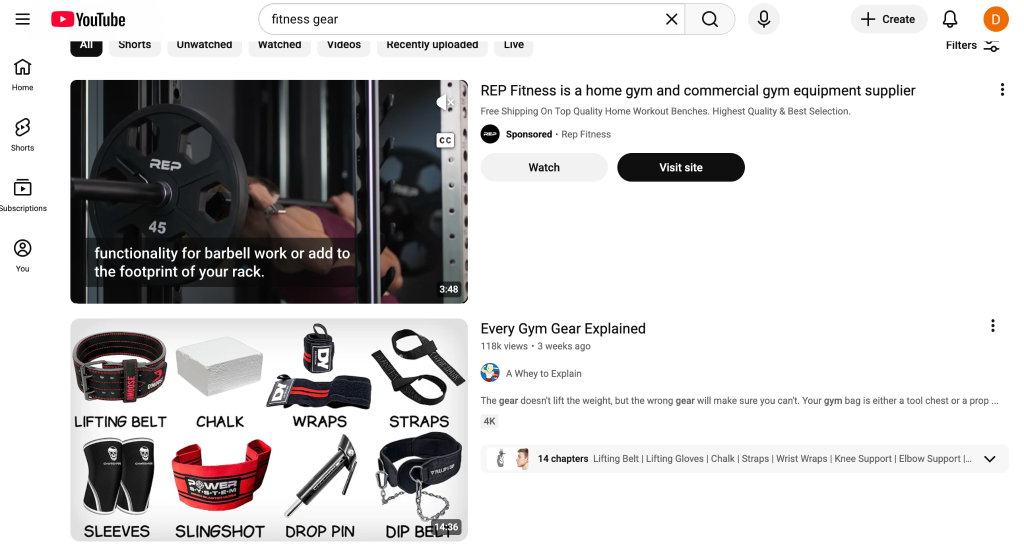
YouTube ads come in several formats, from skippable and non-skippable in-stream ones to in-feed, bumper, masthead, and YouTube shorts ads. Each placement also varies in length.
Here’s an in-feed ad example in search results:
Features
- With YouTube ads, you can reach a global audience and target precise demographics and people with specific interests.
- You need more resources to produce a video ad: from filming to editing and sound, this isn’t as easy as other paid advertising methods.
- Video ads, especially unskippable ones, quickly irritate viewers, so you likely only have one chance to convince them to click your link.
- YouTube ads can be expensive, and the competition is higher, as major brands and advertisers also want to secure placements.
Proven strategies to promote affiliate links
Promoting affiliate links for the program you’ve joined takes more than choosing the right channel. We’ve listed some of the best tactics you can use below.
Create high-quality content
People trust those who can provide valuable information and convince them to make a purchase using their expertise. No matter your affiliate marketing niche, you should put effort into making your content.
This means choosing relevant topics, doing your research, taking time to thoroughly use a product before posting a review, creating high-quality visuals, etc. Before making any big changes, do a content audit for your blog and find opportunities for improvement.
Bri from the Nomad in Japan writes articles about her first-hand experiences and uses evocative photos she takes herself to make the content more engaging for readers:

Build an email list
If you have an audience on social media or a stable website traffic, email is the best supporting channel for you. The direct line of contact to your readers means that you can reliably promote affiliate links, digital products, and your new content.
You can set up a welcome or lead magnet email sequence to automatically send emails to your new subscribers. After that, keep in touch with your email audience and send helpful content, so they don’t unsubscribe.
Use product reviews and comparisons
People search for product reviews and comparisons when they intend to make a purchase. This commercial intent means that they may click your links if your content is convincing enough for them. Make sure you provide enough details and actionable information to ease their decision-making.
Focus on search intent
When you create content for organic search, choose keywords that correspond with commercial intent. For example, “best trips to book in Rome,” “MacBook review,” or “staying in Tokyo vs Kyoto.”
People who use these queries are considering a purchase, so targeting them is the most effective way to get conversions. Plus, commercial intent-focused content is a natural place to promote affiliate links.
Promote affiliate links with SEO
When you make content, make sure you optimize it for search visibility. The strategies here range from doing keyword and competitor research to interlinking and using FAQ blocks.
If you’re already well-versed in SEO for your website or blog, consider content updates. It is an easy way to get more traffic without writing new articles.
This article on the Discover Over There blog was originally written in 2024, but this year, the author updated it to keep the content fresh and effective:

Use affiliate funnels and landing pages
The affiliate marketing funnel considers the whole customer journey to gradually nurture them to conversion. This step-by-step process helps you understand what your audience needs and get more conversions.
Landing pages are fundamental to most funnels. For example, the journey may start from an SEO blog article, continue to a lead magnet landing page with an email form, and eventually lead to emails with affiliate links.
Repurpose content across platforms
If you have a popular blog article, it only makes sense to create a video, a series of social media posts, or an email newsletter out of it. This strategy doesn’t require additional research efforts – you just add more distribution channels for the content you already produced. More marketing channels mean more opportunities to promote your affiliate links and get conversions.
Common mistakes when promoting affiliate links
Mistakes can compromise even the best promotion strategies. Here are some typical ones you should avoid.
- Posting links without content. Links without context and explanation look spammy. And if your audience doesn’t trust that what you’re sharing is helpful, they won’t click.
- Promoting too many products. Including several links in one post makes it less effective. Focus on one product, especially if you’re working with short-form content, like emails or social media posts.
- Ignoring SEO. Keyword research and content optimization help you get discovered. If you don’t follow the best practices, you get less organic traffic, if any visitors at all.
- No audience targeting. Every affiliate offer has its target customer. When you ignore your audience’s characteristics, the content simply doesn’t reach the right people. With free channels, it only affects conversions, but if you’re using the ads, it can also cost you a lot of money.
- Direct-linking ads. Many platforms explicitly prohibit linking straight to the ad. If you violate the rules, you get banned or fined. To stay compliant, you need to link to a bridge page, which then leads to the affiliate product.
- No tracking. Without analytics, you’re acting blindly: you won’t know how to replicate good results and what went wrong if you were unsuccessful. For your promotion strategy to work and improve over time, you need to know which links and content pieces generate the most clicks and conversions.
- Focusing only on commissions. Trust is everything, so you shouldn’t promote low-quality or irrelevant products just because your pay will be higher.
- Promoting low-quality offers. If you want to earn with affiliate marketing, you need to think about the long-term perspective. Your success depends on a strong relationship with your audience, and low-quality products you promote can harm it. Before joining an affiliate program and promoting something, make sure the offer is genuinely valuable.
How to track affiliate link performance
You can track how effective your affiliate links are in several ways:
- UTM tags are specific parameters you add to your links to specify traffic source, campaign, etc. They help to clearly separate performance results in Google Analytics and other tools.
- SubIDs are link parameters that allow you to know what link placement brought conversions. With SubIDs, you can distinguish between different links even if the traffic source was the same. They show up in your affiliate network’s reporting and can be combined with UTMs.
- CTR (click-through rate) shows the percentage of people who clicked on your link after seeing it. Using it, you can compare the performance of buttons to regular links, understand the effectiveness of different placements, and set performance benchmarks for future use.
- Conversion rate is the metric that shows the percentage of people who have purchased a product or service following your link. It helps you estimate how effective your promotions are and also see whether the traffic you’re getting is good. If the CTR is high but the conversion rate is significantly lower, you might be targeting the wrong audience.
- EPC (earnings per click) measures your average earnings from a click. This metric indicates how profitable an affiliate program is for you. If you’re using several ones, this can help you decide which one deserves more attention.
- A/B testing is an experimental strategy of comparing different link versions to see which performs better. You can create two copy or image versions and see how they affect CTRs and conversion rates.
FAQ about promoting affiliate links
Where can I promote affiliate links for free?
You can promote affiliate links for free on your blog or website, on social media, via email, and on online forums, like Reddit, and Q&A platforms, like Quora.
What is the best platform for affiliate marketing?
The best platform for affiliate marketing varies based on the target audience. In general, short-form videos on TikTok and YouTube, email marketing, and blogs offer high return on investment.
Can you promote affiliate links without a website?
Yes, you can promote affiliate links without a website. For example, on social media, forums and groups, and in emails.
Is it legal to post affiliate links on social media?
Yes, it is legal to post affiliate links on social media if you follow platform-specific guidelines. You need to properly disclose them and sometimes use a bridge page instead of direct linking.
How do beginners promote affiliate links?
Beginners should focus on free promotion methods and start by producing high-quality content to build trust with the audience. Depending on your niche and target customers, you can explore social media platforms, like TikTok or Instagram, or create a blog.
Can I run ads directly to affiliate links?
You can run ads for affiliate links, but you can’t link directly to the affiliate offer, or you risk being banned. Instead, your ad should link to a bridge page, which then links to the affiliate product or service you’re promoting.