How to build an email list for affiliate marketing: TL;DR
| Step | Purpose |
| Choose a niche | Attract the right audience |
| Create a lead magnet | Collect subscribers |
| Build a landing page | Convert visitors |
| Set up email software | Manage your list |
| Create email sequences | Build trust |
| Promote affiliate offers | Generate commissions |
What is an affiliate marketing email list?
An affiliate marketing email list is a database of email addresses that people shared with you to receive your messages. Your email list can also include other personal information like names, countries, phone numbers, etc., depending on what information you asked your subscribers to share.
Many countries have laws prohibiting spam, meaning sending emails without recipients’ explicit consent, so you can’t simply message someone whose address you found on the internet. That’s why collecting emails for your list is the only legitimate way to reach out to your audience.
Why building an email list matters for affiliate marketing
Email marketing might seem old-fashioned, yet it still helps marketers all over the world make sales. Email marketing allows you to establish a direct relationship with each customer and move them down the sales funnel until they are ready to make a purchase. In fact, much of the long-term profits can be attributed to promotions via affiliate marketing email campaigns, due to increased user loyalty.
Starting an email list for affiliate marketing can be beneficial in many different ways:
- Get a direct line of communication with your audience. When you send an email, it lands in your subscribers’ inboxes, no matter what. Thanks to segmentation and personalization, you can make your messages even more targeted and relevant.
- Boost conversions. Litmus reports that the average email conversion rate is 3% – 4%, which is highly effective. Plus, when email becomes an additional touchpoint and promotion channel, you increase overall conversions, too.
- Earn regular affiliate income. If you establish trust with your subscribers, you will increase opportunities to convert them into loyal customers. The key is to focus on bringing value and not to come across as “salesy.”
- Shield yourself from algorithm changes. Both social media and Google constantly tweak and update their content recommendation engines. It means that you can’t count on stable traffic. Sometimes, your audience reach or SERP rankings can unexpectedly drop, affecting your income. With email, you don’t have to worry about that – your communication with the audience stays consistent.
- Own your contact list. Email is an owned channel, meaning you don’t depend on social media or another platform and can move your list whenever you want. You are the owner of your customers’ data, which protects your affiliate marketing strategy from any platform shutdowns, blocks, etc.
How to build an email list for affiliate marketing step-by-step
Now that you know the advantages of email marketing, let’s take action by creating your first email list for affiliate marketing.
Step 1. Choose your niche and audience
If you are an affiliate newbie, begin your journey by selecting the right niche. This is the foundation of any successful affiliate business, and we recommend that you approach this choice responsibly. An ideal niche has low competition, high commissions, a good demand level, and profitable affiliate programs.
Once you’ve made your choice, think of your target audience. Who do you want to reach with your email campaigns? What are their demographics, like age, country, profession, and interests? What are their needs and pain points?
Create a detailed portrait of your audience to make it easier to create a lead magnet and email content.
Travel is a booming niche for affiliate marketing, with many programs to choose from. If you’re interested in making money while journeying across the globe, join the Travelpayouts Partnership Platform. With over 90 brands in one place and smart monetization tools, you can focus on making content instead of worrying about the technical details.
Join the Travelpayouts partnership platform
Join todaybrands
Step 2. Create an irresistible lead magnet
A lead magnet is a valuable piece of content you offer to convince your target audience to share their contact information with you.
It can be anything that comes to your imagination and aligns with your audience’s interests. Some of the popular lead magnets to get an email list for affiliate marketing include:
- Checklist
- E-book
- Template
- Free course
- Resource list
For example, if your niche is travel, you can create a night flight essentials checklist, an e-book, or a resource list for international tourists traveling to a particular country, a family trip template, or a free course on solo travel photography.
Make sure to fulfill your promise and provide your audience with what they signed up for. Otherwise, they could end up unsubscribing quickly, leaving you with no contact and a bad reputation.
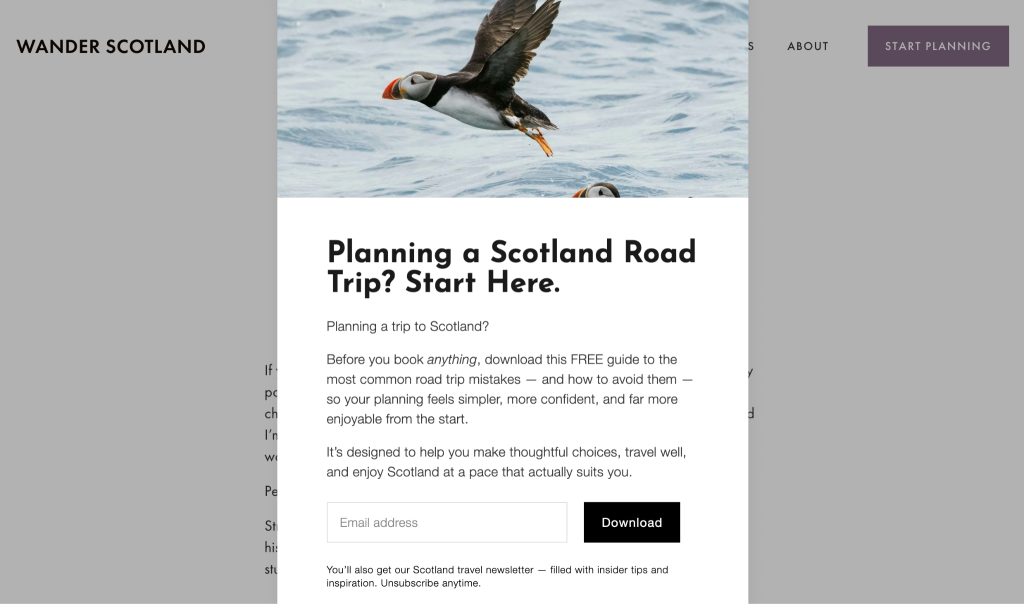
So, how to build an email list for affiliate marketing using a lead magnet? Here are a few ideas that will help you get subscribers:
- Identify the problems that your target audience is trying to solve. Put yourself in their shoes and ask: What challenges do they want to overcome?
- Decide on the value proposition of your lead magnet. Make sure the description clearly states the offer, the file is easy to download, and follows up on your promise.
- Choose the best lead magnet type. There are numerous types of lead magnets you can offer, but some of the most effective ones include visual content, access to online software, and monetary value.
Step 3. Build a landing page or squeeze page
A squeeze page, also called a landing page, is a fundamental part of your affiliate marketing funnel. It is a page created to collect email addresses and other contact information your leads may want to share. The name refers to “squeezing” emails out of visitors.
To design an efficient squeeze page, it is important to:
- Think up a captivating headline
- Describe your offer’s benefits
- Add a CTA in a contrasting color
- Use social proof
- Remove distractions, such as unnecessary content, difficult navigation, etc.
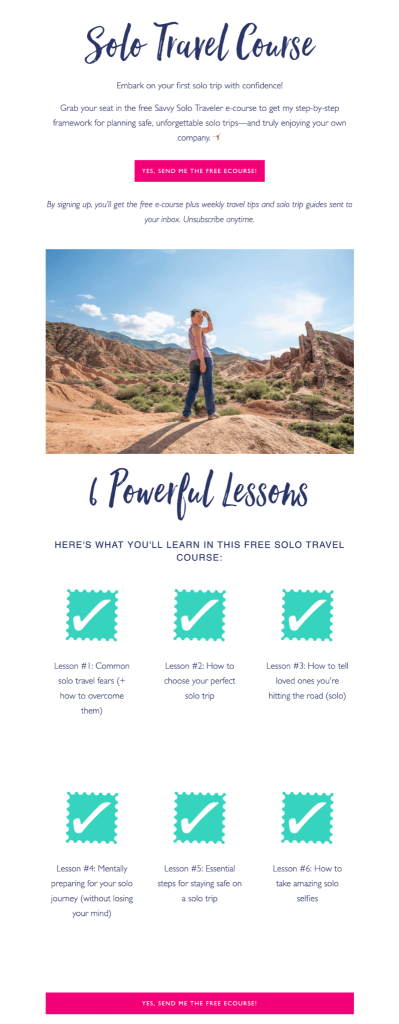
Jessie from the Jessie on a Journey blog offers a free course as a lead magnet. The blogger clearly addresses her audience’s needs and concerns – safety and enjoyment when traveling solo – and shows the course’s contents to motivate visitors to share their contact information. The landing page is simple, serves a single purpose, and has a bright and convincing CTA.
Step 4. Add opt-in forms to your website
An opt-in form gives your website visitors a chance to sign up to regularly get your emails. It is a crucial step in building an affiliate marketing email list as it automatically captures your visitors’ contact information and adds them to your database. To make sure your opt-in form does the hard work for you, you need to design it properly.
Types of opt-in forms
There are two types of opt-in forms: standard or pop-up. Standard forms are embedded into the page content, while pop-up forms appear over the page content, so website visitors won’t miss them.
There are also different types of pop-up forms:
- Entry pop-ups appear when a visitor stays on your site for a certain period of time. The timing needs to be just right to make sure they are already interested in learning more.
- Exit pop-ups show up for visitors who are about to leave your website. These are considered to be one of the most efficient pop-up forms because they are less aggressive to visitors.
- Click pop-ups appear once a visitor clicks certain buttons. This allows you to only engage the interested users and provide a better user experience on your website overall.
Pop-up examples
Here are a few examples of pop-ups that will inspire you to design the perfect opt-in form to grow your affiliate marketing email list.
Nature’s Fynd
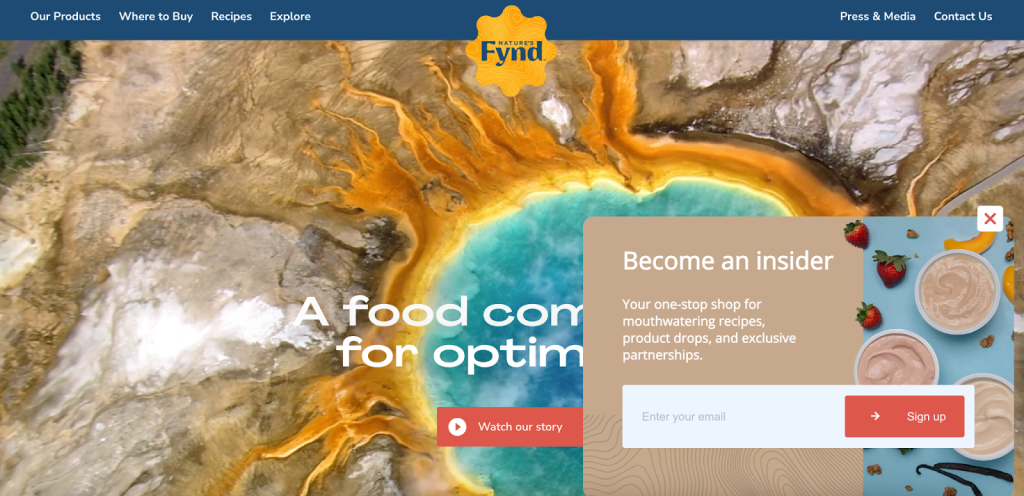
Nature’s Fynd shows an entry pop-up a few seconds after the website loads. Users interested in more information can sign up for the newsletter right away. The pop-up appears in the lower right corner of the page, so the rest of the content remains visible.
Mia Mia Mine
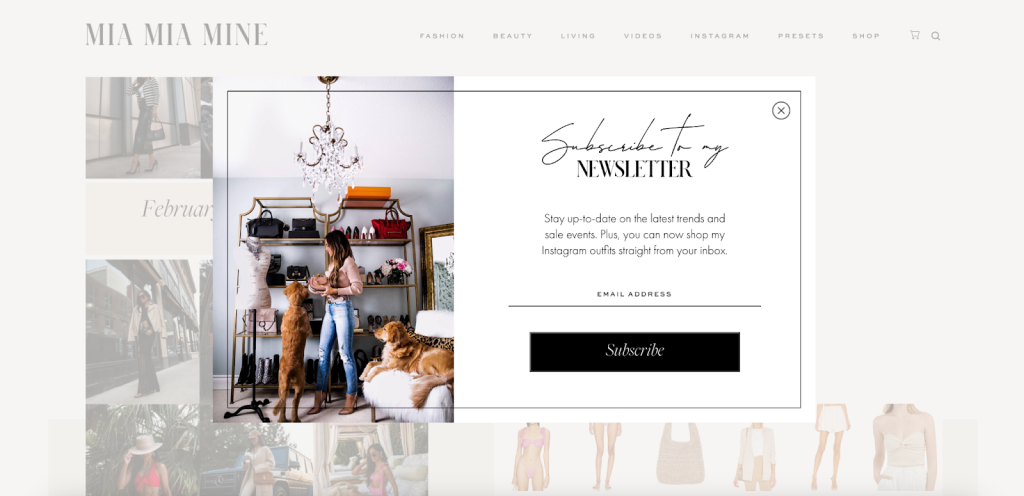
A few seconds after you open the Mia Mia Mine fashion blog, a pop-up form appears right in front of the page content. You will immediately spot a contrasting CTA, a clear offer description, a short one-field sign-up form, and a photo of the blogger on the left.
Highway Robery

While pop-up forms usually take up only a part of the screen, the one on the Highway Robery website covers the full screen. It offers the visitor the option to sign up to win a free robe, which is enticing.
Tips for creating high-converting forms
- Choose a pop-up creation tool: Some of the most popular software options include OptinMonster, Poptin, Wisepops, and more.
- Pick the right goal: Modern tools offer a variety of pop-up designs based on the purpose of those forms. Some of the most common goals of pop-ups include growing your audience, driving sales, running promotions, etc.
- Customize your form: While you can choose from a range of templates, you also need to add a personal touch so the pop-up aligns with your website design and looks organic.
- Add CTA buttons: Each pop-up form should contain a CTA in a contrasting color, so the user understands where to click to sign up.
- Run A/B testing: Sometimes, the most efficient option is not the most obvious. Make sure to create several forms with different designs and copy and test them to skyrocket your conversions.
Step 5. Choose an email marketing platform
Building an affiliate marketing email list manually can be exhausting, but there is a wide range of online tools to automate your campaigns. To choose the best platform for sending your emails, consider the following:
- Deliverability: You want your emails to get to subscribers’ inboxes, right? Make sure to compare the deliverability rate of different email service providers before choosing one.
- Integrations: If you use several marketing tools, you need software that synchronizes all your data and communications.
- Automation: Choose a provider that has an easy-to-use automation builder for sending campaigns based on different triggers or according to a predetermined schedule.
- Segmentation and personalization: One of the affiliate marketing secrets is that personalized and relevant content resonates with customers more than generic content.
- Tracking: To enhance your email campaigns, make sure your email service provider offers built-in tracking features and analytics.
- Security: Your email service provider should have the right security protocols in place to ensure your emails cannot be accessed by third parties without permission.
Our recommendations for beginners
There is a wide selection of email service providers and email marketing tools available to you. Here are a few suggestions for you to consider:
- Kit (formerly ConvertKit) is an email platform designed with creators in mind. You can use it for free for up to 10,000 subscribers and use automation, landing pages, forms, segmentation, and even sell digital products.
- GetResponse has over 150 integrations with different marketing tools, webinars, and SMS features. The free plan suits those with up to 500 subscribers and provides one landing page and subscription forms.
- ActiveCampaign is well-known for its advanced automation and AI features. All plans start from 1,000 subscribers, and there’s no free plan, so this option is best for those with big subscriber lists and a high level of expertise in email marketing.
- Brevo offers not only an email and automation platform but also a built-in CRM, SMS, WhatsApp campaigns, and AI features. If you have fewer than 2,000 subscribers, you can use the free plan and send up to 300 emails per day.
Step 6. Create a welcome email sequence
A welcome sequence is the emails you send to your subscribers once they join your newsletter. Thanks to marketing automation, you can set up a sequence once, and every new subscriber will automatically get it.
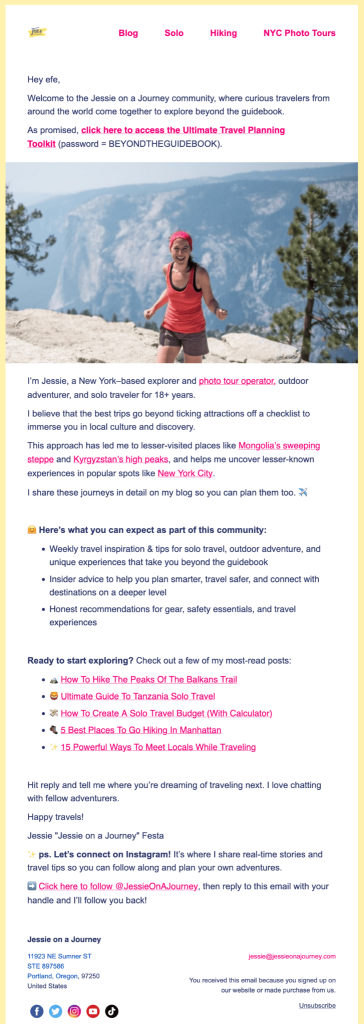
When you use a lead magnet, your first email should include a link to the content you’ve promised. You can also introduce yourself and let your new subscribers know what they will receive in your next emails and what your sending schedule is.
Here’s an example from Jessie with a link to her Ultimate Travel Planning Toolkit. The structure here is well-thought-out, with links to social media and popular blog posts, as well as a bright photo of the blogger herself.
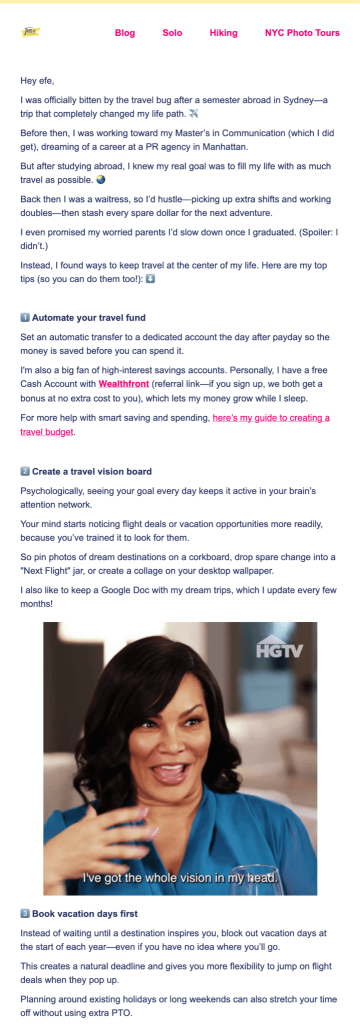
Your next emails should build trust with your audience and provide more value. Give tips, share helpful content, address readers’ needs and pain points to earn credibility and strengthen your relationship.
In her next email, Jessie shares advice on how to make travel a priority. These are practical recommendations her subscribers will likely want to use.
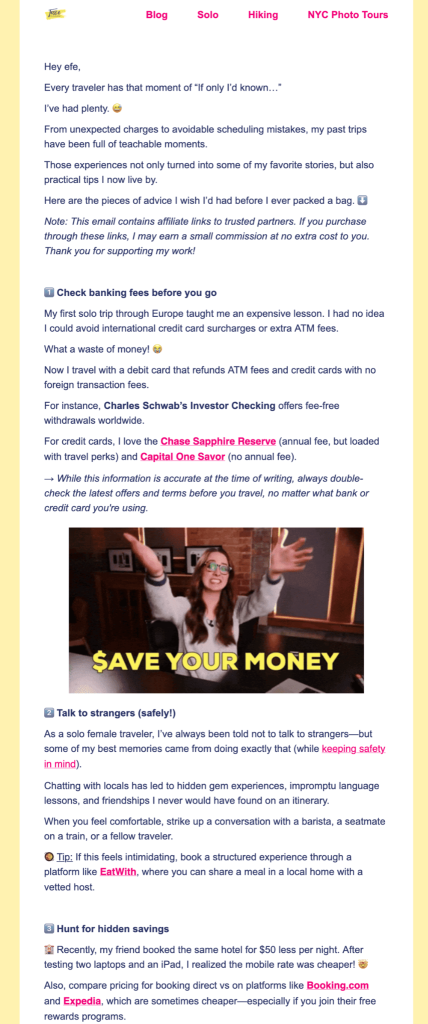
After you send some content-focused emails, you can start sending campaigns promoting affiliate links and offers. Still, even when you’re adding referral links, make sure they are natural and relevant. If you lean too heavily into promotion, your audience might unsubscribe.
Note how Jessie discloses the links at the beginning of the email and clearly explains what’s in it for her readers.
Step 7. Segment and grow your list
Segmentation is one of the best assets of email marketing. It allows you to group your subscribers based on their common traits, like interests or demographics. For example, you can ask your audience about preferences right in the subscription form to create targeted content.
Behavioral segmentation is another popular strategy. You can segment out those who visited specific pages on your website and purchased from you to tailor the message you send to their needs.
Last but not least, create different subscriber subgroups based on engagement. Share exclusive offers with those who open and click on your emails more often and create a re-engagement sequence for those who stopped interacting with your content. For example, send a digest with all of your updates to readers who haven’t opened your emails in a while. You can also borrow an e-commerce tactic and try to win your disengaged subscribers over with a dedicated discount code or another enticing offer.
If some of your subscribers don’t react to the re-engagement efforts, don’t waste your energy and remove them. Cleaning the list saves you money, as you will have fewer contacts, and helps you better evaluate how effective your strategy really is.
Keep expanding your subscribership and segmenting the customers, and email can become an additional way for you to make money with affiliate marketing.
How to grow your email list for affiliate marketing
If you’re a beginner in affiliate marketing, your first step is to build an audience. You can use one or several strategies we describe below.
Blog and SEO traffic
This strategy is one of the most established in affiliate marketing. You perform keyword research and create SEO-focused content to attract traffic from Google and other search engines.
To convert the traffic you get to the blog to email subscribers, insert forms to all or some of your blog pages and set up pop-ups.
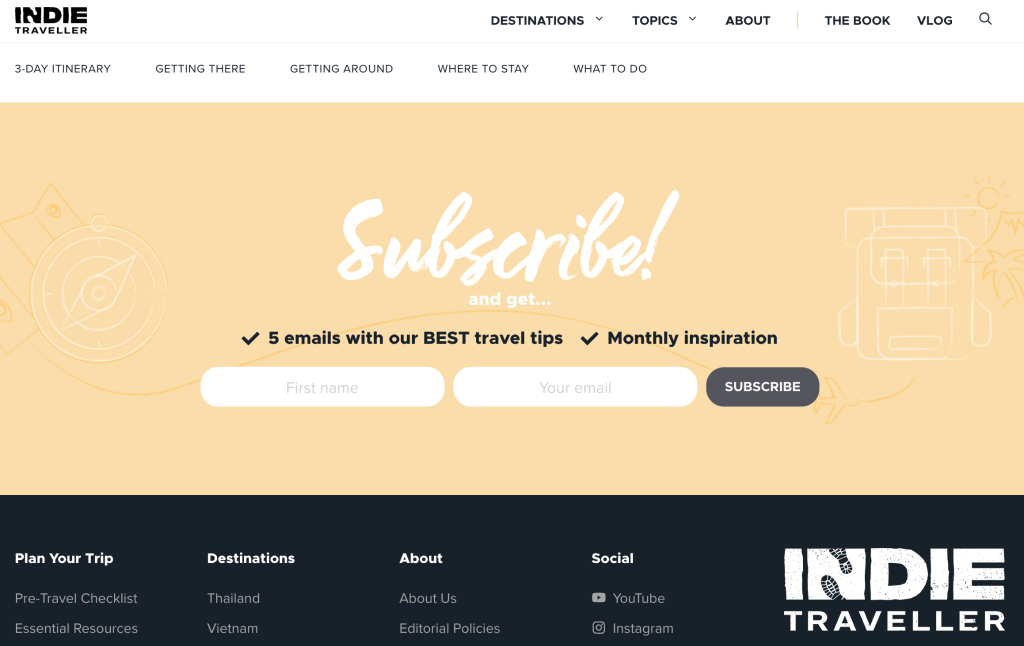
For example, each blog post on the Indie Traveler website has a subscription form at the bottom.
Social media
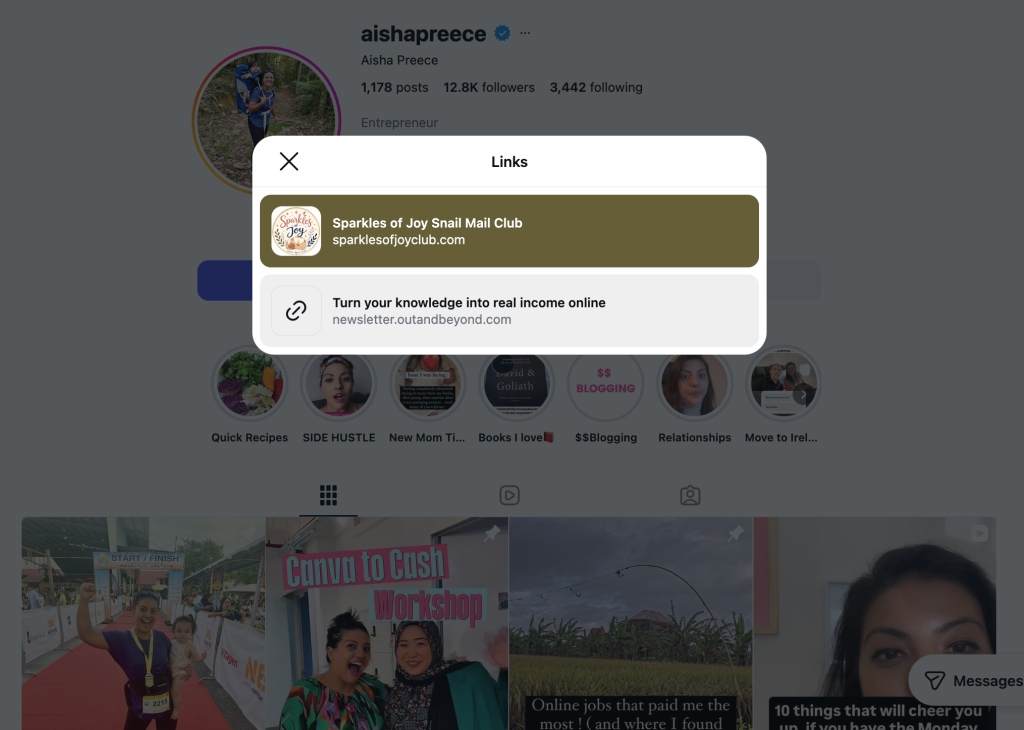
Instagram marketing and email can work great together. You can promote your email list or lead magnet in posts on Instagram, TikTok, and other platforms, and add a link to subscribe in your profile bio.
Here’s an example from Aisha Preece’s Instagram page. The newsletter is prominently featured as the second link in the bio.
YouTube
If you make video content, you don’t have to post a dedicated video to encourage people to subscribe to your newsletter. Start by adding the subscription link to your profile and to the video descriptions, like so:
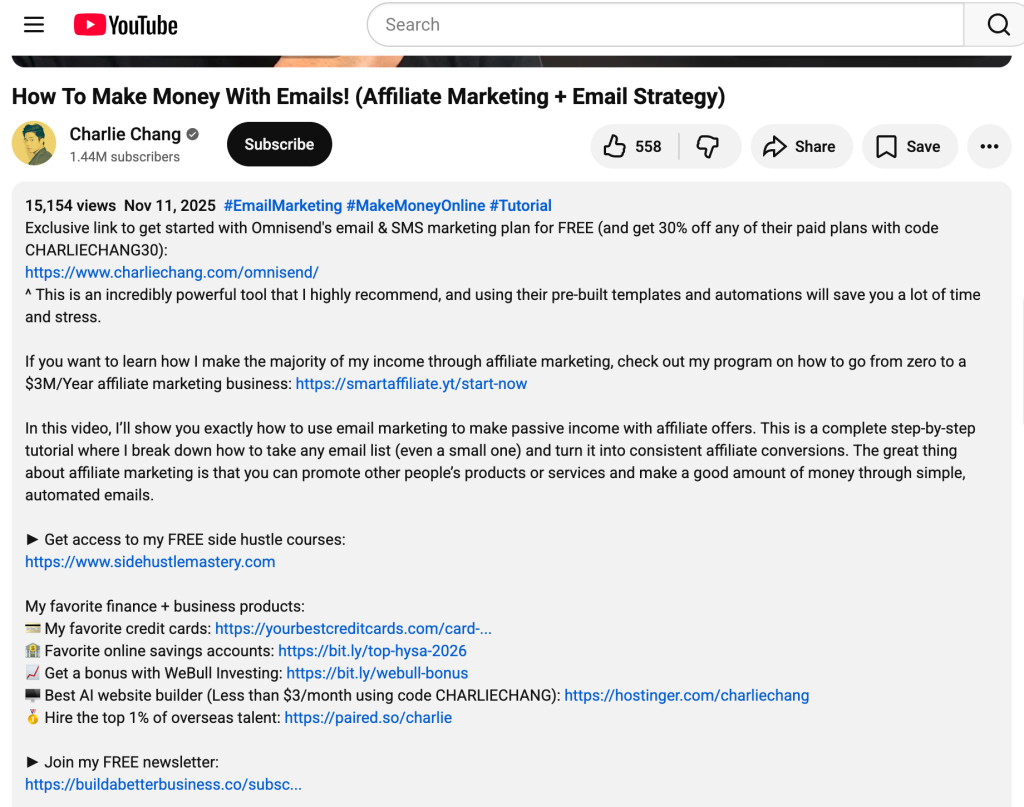
Once you’ve done that, you can create a video on the same topic as your lead magnet and promote it at the end and in the description. This way, you’ll attract an interested audience and highlight the value of your emails.
Post a visual related to your lead magnet on Pinterest with a link, and this platform can bring you new subscribers. Make sure to follow SEO and include relevant keywords in the name and description of your lead magnet. Another Pinterest affiliate marketing best practice is to add a mockup of the content you’re offering. This way, you’ll quickly grab users’ attention and convince them to become your subscribers.
Paid advertising
We’ve covered free opportunities to get subscribers, but you can also use paid advertising as part of your list-building. You can promote your newsletter or the lead magnet on Google or on social media.
If you plan on spending money to attract email subscribers, you need to make sure you’re targeting the right people and gathering analytics to improve your strategy. This requires a level of expertise, but can also bring you results more quickly.
Partnerships and guest posts
If you have a clear understanding of your target audience, you can reach out to bloggers or media they follow and ask for a collaboration. This will be your opportunity to raise awareness by sharing genuinely useful content. You can put a link to your newsletter in your author bio or arrange to promote your publication in the content itself.
If you collaborate on social media, you can also increase your follower count.
Common mistakes when building an affiliate marketing email list
Some mistakes can slow down your progress or, even worse, weaken the impact of your efforts. Learn these email marketing “don’ts” and avoid them:
- Buying email lists. You might think that purchasing subscriber information is a good shortcut, but it is often illegal and unethical. Plus, you might end up with abandoned or old emails and disinterested people who will opt out as soon as you send your first message.
- Promoting offers too early. Any affiliate marketing coach can tell you: you need to build a strong relationship with your audience first before selling to them. If your email subscribers don’t trust your expertise, they won’t purchase the products or services you recommend.
- Weak lead magnets. Your email list-building depends on a relevant lead magnet. Even a well-made piece of content won’t be effective if it doesn’t address your target audience’s needs. Take your time to come up with something your future subscribers will find useful.
- Skipping segmentation. Generic mass emails are less effective than targeted and personalized ones. Group your subscribers based on interests or other criteria to increase conversions and prevent people from unsubscribing.
- Sending too many emails. You might think that constantly showing up in your subscribers’ inboxes is a good idea, but this can irritate them. A couple of times a week or even once every other week is a better cadence than every day. This way, your subscribers will look forward to your messages instead of ignoring them or unsubscribing.
- Ignoring analytics. Email marketing platforms give you access to a wealth of data you can use to improve your strategy. From discovering which content formats or topics resonate with your audience to figuring out the most popular affiliate offers, analytics can be a valuable resource you shouldn’t overlook.
Best practices for affiliate email marketing
Now that you know what to avoid, let’s discuss what you should supplement your strategy with. Follow these tried-and-true tactics:
- Provide value first. Before jumping to promotions, answer your audience’s questions and address their needs. Remember that your subscribers come for helpful content, not just ads.
- Disclose affiliate relationships. Not only does this protect you from legal issues, but this transparency also shows your subscribers respect.

- Personalize emails. Personalization, like addressing subscribers by name, referencing their previous actions on your website, or their interests, makes your emails more targeted and, yes, personal. It helps to establish and maintain a closer relationship.
- Test subject lines. Subject lines directly affect your conversions: if subscribers don’t open your emails, they won’t see the affiliate offers. Use A/B testing to compare the performance of different subject lines and find out what works best for your audience.
- Focus on trust. Affiliate marketing works best as long as your relationship with the audience is strong. Establish your reputation by providing expert content and sharing your authentic experience, and your subscribers will act on your advice.
FAQ about building an email list for affiliate marketing
How to get an email list for affiliate marketing?
To get an email list for affiliate marketing, create a lead magnet your audience will be interested in, promote it on your blog and social media, and make people opt in to your list to get the content.
Is it possible to build a free email list for affiliate marketing?
Yes, it is possible to build a free email list for affiliate marketing. Use your blog and SEO traffic, social media, YouTube, Pinterest, and guest posting or collaborations to motivate people to subscribe to your newsletter.
How long does it take to grow an affiliate marketing email list?
Growing an affiliate marketing email list can take from two to four months or longer, depending on your content strategy, existing audience, and channels you use.
How many subscribers do I need to make money?
This depends on your niche, relationship with the audience, average conversion rate, and affiliate marketing strategy. There’s no universal recommendation, and even a list of 500 people can work effectively.
Can I put affiliate links directly in emails?
You can put affiliate links directly in emails. However, you need to disclose them and make sure that your email service provider and affiliate programs allow it.
What is the best email platform for affiliate marketing?
The best email platform for affiliate marketing depends on your budget, level of expertise, desired features, and list size. Kit is a free and popular option, while ActiveCampaign offers advanced automation and AI. GetResponse is a good choice if you want to host webinars and send SMS, and Brevo has a CRM, SMS, and WhatsApp messaging.
Final thoughts about building an email list for affiliate marketing in 2026
It’s never too early to start growing your email list for affiliate marketing. This owned channel can protect your strategy and become an additional income source.
If you’re a travel content creator, join the Travelpayouts Partnership Platform. You can see monetization data and affiliate programs across your blog, newsletter, and social media in one place.
Join the Travelpayouts partnership platform
Join todaybrands